
[CBSE] Q 79 Solution Accounting Ratios of TS Grewal (2023-24)

Solution of Question number 79 of the Accounting Ratios of TS Grewal Book 2023-24 CBSE Board?

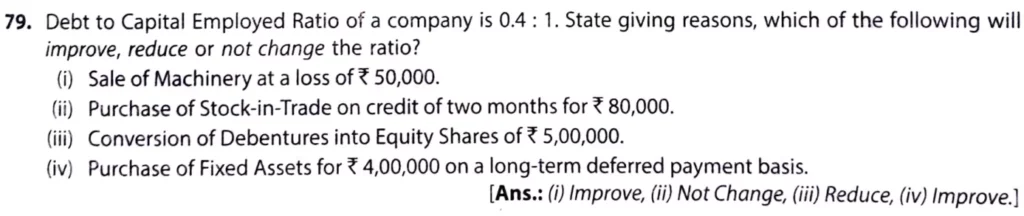
Debt to Capital Employed Ratio of a Company is 0.4 : 1. State giving reasons, which of the following will improve, reduce or not change the ratio?
(i) Sale of Machinery at a loss of ₹ 50,000.

(ii) Purchase of Stock-in-Trade on Credit of two months for ₹ 80,000.
(iii) Conversion of Debentures into Equity Shares of ₹ 5,00,000.
(iv) Purchase of Fixed Assets for ₹ 4,00,000 on a long term deferred payment basis.
[Ans.: (i) Improve, (ii) Not Change, (iii) Reduce, (iv) Improve.]
Solution:-
Solution:-
(i) Sale of Machinery at a loss of ₹ 50,000.
Let’s analyze the impact of selling machinery at a loss of ₹ 50,000 on the debt-to-capital employed ratio
Debt-to-Capital Employed Ratio Formula
Debt-to-Capital Employed Ratio
= Long-Term Debt\Capital Employed
Long-Term Debt = ₹ 80,000
Capital Employed:- ₹ 2,00,000 Includes shareholders’ funds and long-term liabilities (total equity + total debt).
= 80,000/2,00,000 = 0.4 : 1
Impact of Selling Machinery
1. Loss of ₹ 50,000:-
- A loss of ₹ 50,000 reduces shareholders’ funds (reserves or retained earnings), which are part of capital employed.
- The long-term debt remains unchanged.
- Revised Values
- Initial Capital Employed: ₹ 2,00,000
- Reduction in Shareholders’ Funds: ₹ 50,000
- Revised Capital Employed: 2,00,000 – 50,000 = ₹ 1,50,000
1. Recalculate Debt-to-Capital Employed Ratio:
Debt-to-Capital Employed Ratio
= Long-Term Debt\Capital Employed
= 80,000/1,50,000 = 0.533 : 1 (approx.)
Impact
The debt-to-capital employed ratio Improves from 0.4 : 1 (before the sale) to approximately 0.533 : 1, reflecting higher reliance on debt compared to capital employed.
(ii) Purchase of Stock-in-Trade on Credit of two months for ₹ 80,000.
If we consider debt only as long-term liabilities, the purchase of stock-in-trade on credit for two months typically does not directly impact the debt-to-capital employed ratio. Here’s the reasoning:
Debt-to-Capital Employed Ratio Formula:
= Long-Term Debt\Capital Employed
- Long-Term Debt: ₹ 1,20,000
- Capital Employed: ₹ 3,00,000 (includes shareholders’ equity and long-term debt)
= 1,20,000/3,00,000 = 0.4 : 1
Impact of the Transaction:
1. Credit Purchase:
The purchase of stock-in-trade on credit creates current liabilities (accounts payable), which are not part of long-term debt.
Therefore, long-term debt remains unchanged.
2. Capital Employed Unaffected:
- Since the transaction does not impact long-term liabilities or shareholders’ funds, Capital employed remains unchanged.
Final Impact:
- With long-term debt and capital employed staying constant, the debt-to-capital employed ratio remains unchanged at:
Debt-to-Capital Employed Ratio
= 1,20,000/3,00,000} = 0.4 : 1
(iii) Conversion of Debentures into Equity Shares of ₹ 5,00,000.
The conversion of ₹ 5,00,000 worth of debentures into equity shares will reduce the debt-to-capital employed ratio, and here’s why:
Debt-to-Capital Employed Ratio Formula:
Debt-to-Capital Employed Ratio
= Long-Term Debt\Capital Employed
- Initial Values:
- Long-Term Debt (before conversion): ₹ 6,00,000
- Capital Employed (before conversion): ₹ 15,00,000
- Debt-to-Capital Employed Ratio: = 6,00,000/15,00,000} = 0.4 : 1
1. Impact of Conversion:
- Converting debentures (a long-term liability) into equity reduces long-term debt by ₹ 5,00,000, leaving: 6,00,000 – 5,00,000 = ₹ 1,00,000
- The same amount is added to shareholders’ equity, but capital employed (the sum of long-term debt and shareholders’ funds) remains unchanged at ₹ 15,00,000.
2. Revised Values:
- Long-Term Debt (after conversion): ₹ 1,00,000
- Capital Employed (unchanged): ₹ 15,00,000
New Debt-to-Capital Employed Ratio:
Debt-to-Capital Employed Ratio
= 1,00,000/15,00,000 = 0.067 : 1 (approx)
Impact:
- The ratio decreases from 0.4 : 1 to approximately 0.067 : 1, indicating a significantly lower reliance on debt compared to total capital employed.
(iv) Purchase of Fixed Assets for ₹ 4,00,000 on a long term deferred payment basis.
The purchase of fixed assets for ₹ 4,00,000 on a long-term deferred payment basis will impact the debt-to-capital employed ratio as follows:
Debt-to-Capital Employed Ratio Formula:
Debt-to-Capital Employed Ratio = Long-Term Debt\Capital Employed
1. Initial Values:
- Long-Term Debt (before transaction): ₹ 6,00,000
- Capital Employed (before transaction): ₹ 15,00,000
- Debt-to-Capital Employed Ratio:
= 6,00,000/15,00,000} = 0.4 : 1
2. Impact of the Transaction:
- Since the fixed assets are purchased on a long-term deferred payment basis, the long-term debt increases by ₹ 4,00,000.
- The new long-term debt becomes: = 6,00,000 + 4,00,000 = ₹ 10,00,000
- Capital Employed also increases because long-term debt is included in capital employed. The new capital employed becomes: = 15,00,000 + 4,00,000 = ₹ 19,00,000
3. Revised Debt-to-Capital Employed Ratio:
Debt-to-Capital Employed Ratio
= Long-Term Debt\Capital Employed
= 10,00,000/19,00,000 = 0.526 : 1 (approx.)
Impact:
- The debt-to-capital employed ratio improves from 0.4 : 1 to approximately 0.526 : 1, reflecting higher reliance on debt compared to capital employed.
Here is the list of all Solutions.
| S.N | Questions |
| 1 | Question – 1 |
| 2 | Question – 2 |
| 3 | Question – 3 |
| 4 | Question – 4 |
| 5 | Question – 5 |
| 6 | Question – 6 |
| 7 | Question – 7 |
| 8 | Question – 8 |
| 9 | Question – 9 |
| 10 | Question – 10 |
| S.N | Questions |
| 11 | Question – 11 |
| 12 | Question – 12 |
| 13 | Question – 13 |
| 14 | Question – 14 |
| 15 | Question – 15 |
| 16 | Question – 16 |
| 17 | Question – 17 |
| 18 | Question – 18 |
| 19 | Question – 19 |
| 20 | Question – 20 |
| S.N | Questions |
| 21 | Question – 21 |
| 22 | Question – 22 |
| 23 | Question – 23 |
| 24 | Question – 24 |
| 25 | Question – 25 |
| 26 | Question – 26 |
| 27 | Question – 27 |
| 28 | Question – 28 |
| 29 | Question – 29 |
| 30 | Question – 30 |
| S.N | Questions |
| 31 | Question – 31 |
| 32 | Question – 32 |
| 33 | Question – 33 |
| 34 | Question – 34 |
| 35 | Question – 35 |
| 36 | Question – 36 |
| 37 | Question – 37 |
| 38 | Question – 38 |
| 39 | Question – 39 |
| 40 | Question – 40 |
| S.N | Questions |
| 41 | Question – 41 |
| 42 | Question – 42 |
| 43 | Question – 43 |
| 44 | Question – 44 |
| 45 | Question – 45 |
| 46 | Question – 46 |
| 47 | Question – 47 |
| 48 | Question – 48 |
| 49 | Question – 49 |
| 50 | Question – 50 |
| S.N | Questions |
| 51 | Question – 51 |
| 52 | Question – 52 |
| 53 | Question – 53 |
| 54 | Question – 54 |
| 55 | Question – 55 |
| 56 | Question – 56 |
| 57 | Question – 57 |
| 58 | Question – 58 |
| 59 | Question – 59 |
| 60 | Question – 60 |
| S.N | Questions |
| 61 | Question – 61 |
| 62 | Question – 62 |
| 63 | Question – 63 |
| 64 | Question – 64 |
| 65 | Question – 65 |
| 66 | Question – 66 |
| 67 | Question – 67 |
| 68 | Question – 68 |
| 69 | Question – 69 |
| 70 | Question – 70 |
| S.N | Questions |
| 71 | Question – 71 |
| 72 | Question – 72 |
| 73 | Question – 73 |
| 74 | Question – 74 |
| 75 | Question – 75 |
| 76 | Question – 76 |
| 77 | Question – 77 |
| 78 | Question – 78 |
| 79 | Question – 79 |
| 80 | Question – 80 |
| S.N | Questions |
| 81 | Question – 81 |
| 82 | Question – 82 |
| 83 | Question – 83 |
| 84 | Question – 84 |
| 85 | Question – 85 |
| 86 | Question – 86 |
| 87 | Question – 87 |
| 88 | Question – 88 |
| 89 | Question – 89 |
| 90 | Question – 90 |
| S.N | Questions |
| 91 | Question – 91 |
| 92 | Question – 92 |
| 93 | Question – 93 |
| 94 | Question – 94 |
| 95 | Question – 95 |
| 96 | Question – 96 |
| 97 | Question – 97 |
| 98 | Question – 98 |
| 99 | Question – 99 |
| 100 | Question – 100 |
| S.N | Questions |
| 101 | Question – 101 |
| 102 | Question – 102 |
| 103 | Question – 103 |
| 104 | Question – 104 |
| 105 | Question – 105 |
| 106 | Question – 106 |
| 107 | Question – 107 |
| 108 | Question – 108 |
| 109 | Question – 109 |
| 110 | Question – 110 |
| S.N | Questions |
| 111 | Question – 111 |
| 112 | Question – 112 |
| 113 | Question – 113 |
| 114 | Question – 114 |
| 115 | Question – 115 |
| 116 | Question – 116 |
| 117 | Question – 117 |
| 118 | Question – 118 |
| 119 | Question – 119 |
| 120 | Question – 120 |
| S.N | Questions |
| 121 | Question – 121 |
| 122 | Question – 122 |
| 123 | Question – 123 |
| 124 | Question – 124 |
| 125 | Question – 125 |
| 126 | Question – 126 |
| 127 | Question – 127 |
| 128 | Question – 128 |
| 129 | Question – 129 |
| 130 | Question – 130 |
| S.N | Questions |
| 131 | Question – 131 |
| 132 | Question – 132 |
| 133 | Question – 133 |
| 134 | Question – 134 |
| 135 | Question – 135 |
| 136 | Question – 136 |
| 137 | Question – 137 |
| 138 | Question – 138 |
| 139 | Question – 139 |
| 140 | Question – 140 |
| S.N | Questions |
| 141 | Question – 141 |
| 142 | Question – 142 |
| 143 | Question – 143 |
| 144 | Question – 144 |
| 145 | Question – 145 |
| 146 | Question – 146 |
| 147 | Question – 147 |
| 148 | Question – 148 |
| 149 | Question – 149 |
| 150 | Question – 150 |
| S.N | Questions |
| 151 | Question – 151 |
| 152 | Question – 152 |
| 153 | Question – 153 |
| 154 | Question – 154 |
| 155 | Question – 155 |
| 156 | Question – 156 |
| 157 | Question – 157 |
| 158 | Question – 158 |
| 159 | Question – 159 |
| 160 | Question – 160 |
| S.N | Questions |
| 161 | Question – 161 |
| 162 | Question – 162 |
| 163 | Question – 163 |
| 164 | Question – 164 |
| 165 | Question – 165 |
| 166 | Question – 166 |
| 167 | Question – 167 |
| 168 | Question – 168 |
| 169 | Question – 169 |
| 170 | Question – 170 |
| S.N | Questions |
| 171 | Question – 171 |
| 172 | Question – 172 |
| 173 | Question – 173 |
| 174 | Question – 174 |
| 175 | Question – 175 |
| 176 | Question – 176 |
| 177 | Question – 177 |
| 178 | Question – 178 |
| 179 | Question – 179 |
| 180 | Question – 180 |
| 181 | Question – 181 |
| 182 | Question – 182 |

Thanks