
[CBSE] Q. 63 Solution of Accounting Ratios TS Grewal Class 12 (2025-26)

Solution of Question 63 Accounting Ratios of TS Grewal Book 2025-26 session CBSE Board?

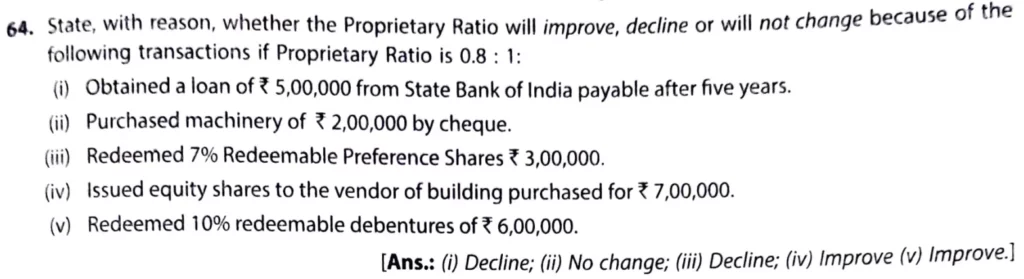
State, with reason, whether the Proprietary Ratio will improve, decline or will not change because of the following transactions if Proprietary Ratio is 0.8 : 1.
(i) Obtained a loan of ₹ 5,00,000 from State Bank of India payable after five years.

(ii) Purchased machinery of ₹ 2,00,000 by cheque.
(iii) Redeemed 7% Redeemable Preference Shares ₹ 3,00,000.
(iv) Issued equity shares to the vendor of building purchased for ₹ 7,00,000.
(v) Redeemed 10% redeemable debentures of ₹ 6,00,000.
[Ans.: (i) Decline; (ii) No Change, (iii) Decline; (iv) Improve, (v) Improve.]
Solution:-
(i) Obtained a loan of ₹ 5,00,000 from State Bank of India payable after five years.
The proprietary ratio will be affected by obtaining a loan of ₹ 5,00,000 payable after five years, and here’s how:
Proprietary Ratio Formula:
= Shareholder’s Funds/Total Assets
- Shareholders’ Funds: Includes share capital, reserves, and retained earnings.
- Total Assets: Includes both fixed and current assets.
- Effect of Loan:
- By obtaining a loan, total assets increase because the cash received from the loan is added to the company’s assets.
- However, shareholders’ funds remain unchanged, as the loan is a liability and does not affect equity.
- Impact on Proprietary Ratio:
- The numerator (shareholders’ funds) remains constant.
- The denominator (total assets) increases due to the addition of ₹ 5,00,000 from the loan.
- Since the denominator increases while the numerator stays constant, the proprietary ratio will decrease from its original value of 0.8 : 1, reflecting lower reliance on shareholders’ funds compared to total assets.
(ii) Purchased machinery of ₹ 2,00,000 by cheque.
The purchase of machinery worth ₹ 2,00,000 by cheque will affect the proprietary ratio, and here’s how:
Proprietary Ratio Formula:
= Shareholder’s Funda/Total Assets
- Shareholders’ Funds: Includes share capital, reserves, and retained earnings.
- Total Assets: Includes both fixed and current assets.
- Impact of Transaction:
- Purchasing machinery increases fixed assets (part of total assets) by ₹ 2,00,000.
- Simultaneously, paying via cheque reduces cash/bank balance, so the total assets remain unchanged.
- Shareholders’ funds are also unaffected because this transaction does not involve equity adjustments.
- Final Effect:
- Since neither the numerator (shareholders’ funds) nor the denominator (total assets) changes, the proprietary ratio remains the same at 0.8 : 1.
(iii) Redeemed 7% Redeemable Preference Shares ₹ 3,00,000.
Given the assumed values:
- Shareholders’ Funds (before redemption): ₹ 8,00,000
- Total Assets (before redemption): ₹ 10,00,000
Let’s calculate the proprietary ratio before redemption:
Proprietary Ratio
= Shareholder’s Funds/Total Assets =
= 8,00,000/10,00,000 = 0.8 : 1
Now, consider the redemption of ₹ 3,00,000 preference shares:
- Shareholders’ Funds (after redemption): [ 8,00,000 – 3,00,000 = ₹ 5,00,000 ]
- Total Assets (after redemption): [ 10,00,000 – 3,00,000 = ₹ 7,00,000 ]
Recalculate the proprietary ratio after redemption:
Proprietary Ratio = Shareholders’ Funds\Total Assets
= 5,00,000/7,00,000 = 0.714 : 1 (approx)
Impact: The proprietary ratio decreases from 0.8 : 1 to 0.714 : 1, reflecting reduced reliance on shareholders’ funds relative to total assets.
Reason:-
Shareholders’ Funds:– Includes equity share capital, reserves, and retained earnings. Preference shares (redeemable) are part of shareholders’ funds until redeemed.
Total Assets:- Includes all fixed and current assets.
Impact of Redemption:– Redeeming preference shares decreases shareholders’ funds by ₹ 3,00,000, as this amount is paid out to the preference shareholders.
If the redemption is made from cash or bank balances, total assets also decrease by ₹ 3,00,000.
(iv) Issued equity shares to the vendor of building purchased for ₹ 7,00,000.
Let’s analyze the effect of issuing equity shares to the vendor for a building worth ₹ 7,00,000, given:
- Shareholders’ Funds (before transaction): ₹ 8,00,000
- Total Assets (before transaction): ₹ 10,00,000
Proprietary Ratio (before transaction):
= Shareholders’ Funds\Total Assets
= 8,00,000/10,00,000 = 0.8 : 1
Effects of the Transaction:
- Increase in Shareholders’ Funds:
- Equity shares worth ₹ 7,00,000 are issued, increasing shareholders’ funds to: [ 8,00,000 + 7,00,000 = ₹ 15,00,000 ]
- Increase in Total Assets:
- The building is added as an asset worth ₹ 7,00,000, increasing total assets to: [ 10,00,000 + 7,00,000 = ₹ 17,00,000 ]
Proprietary Ratio After the Transaction:
Proprietary Ratio} = Shareholders’ Funds\Total Assets
= 15,00,000/17,00,000
= 0.882 : 1 (approx)
Impact:
The proprietary ratio increases from 0.8 : 1 to approximately 0.882 : 1. This reflects a stronger reliance on shareholders’ funds compared to total assets, indicating improved financial stability.
(v) Redeemed 10% redeemable debentures of ₹ 6,00,000.
Let’s analyze the effect of redeeming ₹ 6,00,000 worth of 10% redeemable debentures, given:
- Shareholders’ Funds (before redemption): ₹ 8,00,000
- Total Assets (before redemption): ₹ 10,00,000
Proprietary Ratio (before redemption):-
Proprietary Ratio = Shareholders’ Funds\Total Assets
= 8,00,000/10,00,000
= 0.8 : 1
Effects of the Redemption:
- No Change to Shareholders’ Funds:
- Redeeming debentures does not affect shareholders’ funds, as these are liabilities and not part of equity.
- Decrease in Total Assets:
- If ₹ 6,00,000 is paid for the redemption from cash or bank balances, total assets will decrease by ₹ 6,00,000.
Revised Values:
- Shareholders’ Funds (after redemption): ₹ 8,00,000 (unchanged)
- Total Assets (after redemption): [ 10,00,000 – 6,00,000 = ₹ 4,00,000 ]
Proprietary Ratio After Redemption:
Proprietary Ratio = Shareholders’ Funds\Total Assets
= 8,00,000/4,00,000
= 2 : 1
Impact:
- The proprietary ratio increases significantly, from 0.8 : 1 to 2 : 1, indicating a stronger reliance on shareholders’ funds relative to total assets.
Here is the list of all Solutions.
| S.N | Questions |
| 1 | Question – 1 |
| 2 | Question – 2 |
| 3 | Question – 3 |
| 4 | Question – 4 |
| 5 | Question – 5 |
| 6 | Question – 6 |
| 7 | Question – 7 |
| 8 | Question – 8 |
| 9 | Question – 9 |
| 10 | Question – 10 |
| S.N | Questions |
| 11 | Question – 11 |
| 12 | Question – 12 |
| 13 | Question – 13 |
| 14 | Question – 14 |
| 15 | Question – 15 |
| 16 | Question – 16 |
| 17 | Question – 17 |
| 18 | Question – 18 |
| 19 | Question – 19 |
| 20 | Question – 20 |
| S.N | Questions |
| 21 | Question – 21 |
| 22 | Question – 22 |
| 23 | Question – 23 |
| 24 | Question – 24 |
| 25 | Question – 25 |
| 26 | Question – 26 |
| 27 | Question – 27 |
| 28 | Question – 28 |
| 29 | Question – 29 |
| 30 | Question – 30 |
| S.N | Questions |
| 31 | Question – 31 |
| 32 | Question – 32 |
| 33 | Question – 33 |
| 34 | Question – 34 |
| 35 | Question – 35 |
| 36 | Question – 36 |
| 37 | Question – 37 |
| 38 | Question – 38 |
| 39 | Question – 39 |
| 40 | Question – 40 |
| S.N | Questions |
| 41 | Question – 41 |
| 42 | Question – 42 |
| 43 | Question – 43 |
| 44 | Question – 44 |
| 45 | Question – 45 |
| 46 | Question – 46 |
| 47 | Question – 47 |
| 48 | Question – 48 |
| 49 | Question – 49 |
| 50 | Question – 50 |
| S.N | Questions |
| 51 | Question – 51 |
| 52 | Question – 52 |
| 53 | Question – 53 |
| 54 | Question – 54 |
| 55 | Question – 55 |
| 56 | Question – 56 |
| 57 | Question – 57 |
| 58 | Question – 58 |
| 59 | Question – 59 |
| 60 | Question – 60 |
| S.N | Questions |
| 61 | Question – 61 |
| 62 | Question – 62 |
| 63 | Question – 63 |
| 64 | Question – 64 |
| 65 | Question – 65 |
| 66 | Question – 66 |
| 67 | Question – 67 |
| 68 | Question – 68 |
| 69 | Question – 69 |
| 70 | Question – 70 |
| S.N | Questions |
| 71 | Question – 71 |
| 72 | Question – 72 |
| 73 | Question – 73 |
| 74 | Question – 74 |
| 75 | Question – 75 |
| 76 | Question – 76 |
| 77 | Question – 77 |
| 78 | Question – 78 |
| 79 | Question – 79 |
| 80 | Question – 80 |
| S.N | Questions |
| 81 | Question – 81 |
| 82 | Question – 82 |
| 83 | Question – 83 |
| 84 | Question – 84 |
| 85 | Question – 85 |
| 86 | Question – 86 |
| 87 | Question – 87 |
| 88 | Question – 88 |
| 89 | Question – 89 |
| 90 | Question – 90 |
| S.N | Questions |
| 91 | Question – 91 |
| 92 | Question – 92 |
| 93 | Question – 93 |
| 94 | Question – 94 |
| 95 | Question – 95 |
| 96 | Question – 96 |
| 97 | Question – 97 |
| 98 | Question – 98 |
| 99 | Question – 99 |
| 100 | Question – 100 |
| S.N | Questions |
| 101 | Question – 101 |
| 102 | Question – 102 |
| 103 | Question – 103 |
| 104 | Question – 104 |
| 105 | Question – 105 |
| 106 | Question – 106 |
| 107 | Question – 107 |
| 108 | Question – 108 |
| 109 | Question – 109 |
| 110 | Question – 110 |
| S.N | Questions |
| 111 | Question – 111 |
| 112 | Question – 112 |
| 113 | Question – 113 |
| 114 | Question – 114 |
| 115 | Question – 115 |
| 116 | Question – 116 |
| 117 | Question – 117 |
| 118 | Question – 118 |
| 119 | Question – 119 |
| 120 | Question – 120 |
| S.N | Questions |
| 121 | Question – 121 |
| 122 | Question – 122 |
| 123 | Question – 123 |
| 124 | Question – 124 |
| 125 | Question – 125 |
| 126 | Question – 126 |
| 127 | Question – 127 |
| 128 | Question – 128 |
| 129 | Question – 129 |
| 130 | Question – 130 |
| S.N | Questions |
| 131 | Question – 131 |
| 132 | Question – 132 |
| 133 | Question – 133 |
| 134 | Question – 134 |
| 135 | Question – 135 |
| 136 | Question – 136 |
| 137 | Question – 137 |
| 138 | Question – 138 |
| 139 | Question – 139 |
| 140 | Question – 140 |
| S.N | Questions |
| 141 | Question – 141 |
| 142 | Question – 142 |
| 143 | Question – 143 |
| 144 | Question – 144 |
| 145 | Question – 145 |
| 146 | Question – 146 |
| 147 | Question – 147 |
| 148 | Question – 148 |
| 149 | Question – 149 |
| 150 | Question – 150 |
| S.N | Questions |
| 151 | Question – 151 |
| 152 | Question – 152 |
| 153 | Question – 153 |
| 154 | Question – 154 |
| 155 | Question – 155 |
| 156 | Question – 156 |
| 157 | Question – 157 |
| 158 | Question – 158 |
| 159 | Question – 159 |
| 160 | Question – 160 |
| S.N | Questions |
| 161 | Question – 161 |
| 162 | Question – 162 |
| 163 | Question – 163 |
| 164 | Question – 164 |
| 165 | Question – 165 |
| 166 | Question – 166 |
| 167 | Question – 167 |
| 168 | Question – 168 |
| 169 | Question – 169 |
| 170 | Question – 170 |
| S.N | Questions |
| 171 | Question – 171 |
| 172 | Question – 172 |
| 173 | Question – 173 |
| 174 | Question – 174 |
| 175 | Question – 175 |
| 176 | Question – 176 |
| 177 | Question – 177 |
| 178 | Question – 178 |
| 179 | Question – 179 |
| 180 | Question – 180 |
| 181 | Question – 181 |
| 182 | Question – 182 |
| 183 | Question – 183 |
| 184 | Question – 184 |
